
Health · Sleep · Updated this week · 9 min read
The Reason Your Night Guard Never Stopped the Clenching: The Muscle in Your Jaw Is Starving, and Your Dentist Never Mentioned It
100-Night Home Trial · 1-Year Guarantee · Free tracked UK delivery
I caught myself doing it on a Tuesday morning in March. Standing at the kitchen counter, kettle on, jaw clamped so tight my back teeth ached before I'd even had a coffee.
I've worn a night guard since I was 38. Two of them, actually. The first from my dentist, the second a hard acrylic one from a private clinic in Manchester, because the first "wasn't strong enough". Between them, £600.
And I started doing the thing I now know every woman with this problem does:
- Pressing my thumbs into the sides of my face in meetings, hoping nobody noticed
- Taking ibuprofen at 7am, before the headache had even properly arrived
- Ordering soup on nights out because chewing hurt
- Sleeping on my back, then my side, then my back again, looking for the position where my jaw would finally let go
If you're reading this and thinking "how does she know exactly what I do", it's because there are millions of us. Up to 1 in 10 adults in the UK clench or grind at night. And we're all doing the same things to manage the same problem.
But here's what nobody told me until eight months ago:
The reason my jaw wouldn't stop clenching had nothing to do with stress. And the reason nothing I'd tried had worked is because every single "solution" was treating the wrong thing.

Here's everything I tried (and why none of it worked):
The dentist's night guard£150 to £600, or £332.10 on the NHS if you can get one
I wore mine every night for three years. Two versions. My teeth stopped wearing down, and I'm grateful for that. But every morning the jaw was exactly the same. Worse, actually, after the hard acrylic one. A guard sits between your teeth and takes the force. It never touches the muscle producing that force. It's a helmet for someone who's being punched all night. The punching doesn't stop. You just stop bruising.
The boil-and-bite guard from Boots£15 to £25
Bulkier, softer, chewed through in a month. Same idea, worse version. I'm not going to mock it, because I bought two.
Botox in the jaw muscle£250 to £450 a session, every three to four months
I did it once, in a clinic off Deansgate. For about ten weeks the clenching eased. Then it came back, and it came back harder. I understand why now: Botox paralyses the muscle for a few months. It doesn't feed it. A paralysed muscle gets even less blood than a clenched one, and when the injection wears off you've got the same starved muscle, plus £350 less.
Ibuprofen and paracetamol at 7amfree, until your stomach objects
This switches off the alarm. It doesn't put out the fire. By 11am the pressure is back behind the eyes.
Jaw stretches and "release" videos on YouTubefree
I saved the video. I did the routine for about nine days. Sound familiar? Even if you stick with it, you're pulling on a muscle that's already knotted. You're stretching a rope that's already tied.
Sleeping differently, a new pillow, magnesium, "reducing stress"£30 to £60 and a lot of guilt
My dentist said stress. The NHS website says stress. So I did the breathing app, the earlier bedtime, the pillow. I was less stressed. I was still clenching. Because stress is what starts the cycle. It isn't what keeps it going.

Do this now. It takes 30 seconds.
Put two fingers on the side of your face, just in front of your ear. Now clench your teeth.
Feel that bulge harden under your fingers? That's the muscle.
Now open your mouth halfway and press into the same spot, firmly, and move your fingers in a small circle.
If it's tender, if you feel a hard knot the size of a grape, if it makes you wince a little, you've just found what this article is about. Most people who clench at night have never touched it. I hadn't.

Then a physiotherapist told me something nobody else had.
Her name is Hannah Reeves. She's a musculoskeletal physio in Leeds, and I went to her for a completely different reason: a shoulder that wouldn't stop aching. Ten minutes in she pressed two fingers into the side of my face, exactly where you just pressed, and I nearly came off the table.
She said:
"The problem isn't your teeth. And it isn't stress. It's a muscle. And that muscle is starving."
There's a muscle on the side of your jaw called the masseter. It's the one that closes your mouth. For its size, it's the strongest muscle in the human body. It can close your jaw with the force of about 90 kilos.
You've heard of it. You've probably never thought about it. Neither had I.

You already know the feeling I'm about to describe, even if you've never connected it to your jaw.
A calf cramp at 3am is a muscle that has locked and cut off its own blood supply. You don't stretch it away. You rub it, you warm it, and the blood comes back, and it lets go. Now imagine that cramp in the strongest muscle in your body. Every night. For years.
Here's what Hannah explained, and what changed everything for me.
Every hour you spend concentrating, at a screen, in traffic, in a meeting, this muscle tightens a little. You don't notice it. By evening it's already loaded. Then you fall asleep, and it does the thing a tired, overloaded muscle does: it locks.
And here's the part nobody mentions. A muscle that stays contracted squeezes its own blood vessels shut. No blood in. No oxygen in. No waste out. For hours.
A muscle without blood doesn't relax. It seizes. It cramps. And a cramping muscle clenches harder. So it starves more. So it clenches harder.
Clench. Starve. Seize. Clench harder. All night. Every night.
That's why you wake up with a jaw you can't open properly. That's the headache behind your eyes: the temporalis, the muscle on the side of your head, is part of the same team, and it's been starving too.
Hannah called it the starving masseter. Once she said it, everything I'd tried made sense.
The NHS itself says a mouth guard will "protect your teeth from damage". Read that again. Protect. Not stop. Nobody ever claimed it would, and nobody ever told me the difference.
That's why the guard didn't work. It sat between my teeth and never touched the muscle doing the clenching.
That's why the Botox came back harder. It paralysed a starving muscle and starved it further.
That's why the stretches felt good for a day. I was pulling on a muscle that needed feeding, not lengthening.
That's why "reducing stress" didn't touch it. Stress lit the match years ago. The fire has been running on its own ever since.
Every solution I'd tried had treated the result of this muscle locking up. Not one of them had treated the muscle itself.

Once I understood this, the question changed. It wasn't "how do I protect my teeth" any more. It was:
"How do I get this muscle to let go?"
Picture Tuesday morning again. Kettle on. You yawn, wide, and nothing catches. You reach for the ibuprofen out of habit and put it back in the drawer. That's what feeding the muscle feels like. That's what I have now.
Clinical-grade jaw muscle release · 100-night home trial
There are really only three ways to feed a starving masseter.
Option 1: Manual release with a physio or a specialist massage therapist
This works. Hannah did it to me on the table and I walked out able to open my mouth wider than I had in a year. The problem is cost and access. Musculoskeletal physio runs £55 to £75 a session in most of the UK, more in London. A proper protocol is twice a week for 8 to 12 weeks, then maintenance. Total: £1,200 to £2,000, on someone else's schedule, in someone else's building. It works. Most people simply can't sustain it. I couldn't.
Option 2: Do nothing and hope it settles
The masseter doesn't un-starve itself, not while you're still concentrating eight hours a day and sleeping on it at night. Every month you wait, the muscle locks tighter, the teeth wear further, and the joint in front of your ear starts to click. What is a tight jaw at 35 is worn-down molars, a clicking joint and daily headaches at 45. The trajectory only goes one direction.
Option 3: Replicate the release at home
This is what I found. A clinical-grade device that does what Hannah's hands did: real heat into the muscle to reopen the blood supply, then targeted pressure and vibration to undo the knot. At home, in 15 minutes, before bed.
One device. Under £100, once. No appointments. No injections. No recurring cost.
It's called NattieRelease.

100-night home trial · 1-year guarantee · Free tracked UK delivery
How NattieRelease feeds the masseter (the same muscle your physio would work on)
NattieRelease uses a precision aluminium tip that sits exactly where Hannah pressed her two fingers: the belly of the masseter, in front of the ear, and the temporalis above it. Combined with 42 to 48°C Deep Heat Perfusion, the temperature that softens connective tissue and reopens the vessels a clench has been crushing, without ever burning the skin. And four levels of TriggerPoint vibration that release the knot from the inside.
Most "facial massagers" are warm to the touch. That is not heat. 42°C at the muscle is heat.
Here's exactly what happens in a 15-minute session:
- 0 to 5 minutes: the Perfusion Phase. The tip warms to 42°C within 40 seconds. You hold it on the masseter and feel the heat sink in. This is blood coming back into a muscle that's been shut for hours. Most people feel the jaw drop a few millimetres on its own in the first two minutes.
- 5 to 10 minutes: the Release Phase. You switch on the vibration and trace the muscle from the cheekbone down to the angle of the jaw, then the temple. The pressure and the pulse do what a physio's thumbs do: they break the knot the clench has tied.
- 10 to 15 minutes: the Reset Phase. Heat and light pressure on both sides. This is the step every night guard skips, and why the clenching always comes back: the muscle goes to bed fed and unloaded, instead of starving and locked.
15 minutes. Before bed. Results compound nightly, because each session means the muscle starts the night with more blood in it than the night before.

What to expect:
Nights 1 to 3: The jaw feels looser going to sleep. Some people wake up the first morning without the headache. Most notice they can open wider when they brush their teeth.
Week 1: The morning headache stops being a given. The sides of your face stop aching by mid-morning.
Weeks 2 to 3: You stop reaching for the ibuprofen. Chewing stops hurting. Your partner mentions the grinding has gone quiet.
Week 4 and beyond: You forget your jaw was ever a problem.
Keep wearing your guard for the first two weeks. Most people stop needing it by week three, and you'll know when. That's when I put mine in a drawer.
£99 once · No subscription · Free tracked delivery
The part I didn't expect.
I bought NattieRelease for the clenching. I was singularly focused on my jaw. But about ten days in, two other things happened.
The headaches went. Not "got better". Went. I hadn't connected the pressure behind my eyes with my jaw, but Hannah wasn't surprised: the temporalis, the muscle you feed in phase three, is the one that refers pain into the forehead and behind the eyes. Feed it, and the headache has nowhere to come from.
Then, about three weeks in, my husband said my face looked different. Slimmer, at the jaw. I hadn't lost weight. Hannah explained that too: a masseter that clenches all night is a masseter that's bulking, like any muscle under constant load. That's why clinics inject Botox into it to slim the jawline. Let the muscle rest and it settles.
Same muscle. Three problems. I paid for the clenching. The headaches and the jawline came free.

What other people are saying
★★★★★“I'd worn a guard for six years. I did NattieRelease every night for a fortnight and woke up on the fifteenth morning without the headache for the first time I can remember. I've put the guard in a drawer.”
Rachel M., 41, Bristol

★★★★★“My dentist wanted £480 for a hard splint. I tried this first. Three weeks in, my husband asked what had happened to the grinding. I hadn't told him I'd started.”
Jennifer L., 46, Glasgow

★★★★★“I'd had Botox twice. Both times it wore off and came back worse. This is the first thing that changed how my jaw feels in the morning rather than just numbing it for a few months.”
Danielle K., 38, London

★★★★★“My wife bought it for me as a last resort before separate bedrooms. I thought it was nonsense. Night six she slept through for the first time in two years. I'm still not sure how I feel about being wrong.”
Tom H., 52, Sheffield

★★★★★“I'm a dental nurse. I rolled my eyes at the 'starving muscle' thing. I'm on night 40 and I haven't worn my splint since night 18. I've stopped rolling my eyes.”
Priya S., 39, Leicester

How NattieRelease compares
| NattieRelease | Night guard | Botox | Physio | |
|---|---|---|---|---|
| Treats the muscle, not the teeth | Yes | No | Partly, by paralysing it | Yes |
| Restores blood flow | Yes | No | No | Yes |
| Works at home | Yes | Yes | No | No |
| Time per session | 15 min | All night | 20 min, every 3 months | 45 min, twice a week |
| Cost | £99 once | £150 to £600 each | £250 to £450 a session | £55 to £75 a session |
| Ongoing cost | None | Replace every 1 to 3 years | £750 to £1,350 a year | £1,200 to £2,000 a course |
Questions I had before I bought it
Will it burn my skin? No. The tip is capped at 48°C, the temperature physios use for tissue warming. It feels like a hot flannel, not a hot pan, and it switches off by itself.
Can I keep using my night guard? Yes, and you should for the first two weeks. NattieRelease works on the muscle before bed; the guard protects your teeth during the night. Most people stop needing the guard by week three.
My jaw clicks. Does this help? The click comes from the joint in front of your ear. In most people it's the starved muscles around it pulling the joint off centre. Feed the muscles and the click usually softens. If your jaw locks open or shut, see a dentist first.
How long and when? 15 minutes, once a day, ideally in the 30 minutes before bed. On bad days, a second session in the morning.
I have implants, crowns or braces. The device never touches your teeth. It works on the outside of the face.
Battery? About 10 sessions per charge, USB-C, charges in 90 minutes.
Who is it not for? Anyone with a recent jaw injury, a dislocation, or a diagnosed joint condition under active treatment: talk to your clinician first. NattieRelease is designed to supplement your dental care, not replace it.
How much I've spent trying to fix this:
- Night guards: £600
- Boil-and-bite guards: £40
- Botox: £350
- Physio, four sessions before I found NattieRelease: £260
- Ibuprofen, paracetamol, a cervical pillow, a breathing app: £110
Total: £1,360. And every morning, the same jaw.
A physio charges £65 because you're paying for her hands, her room and her time. We put the heat and the pressure into a device and cut the rest.
NattieRelease: £99, once.£199
Pack for two: £169.
And there's a reason not to wait for a better day: every month a starved muscle stays starved, it locks a little tighter and the teeth wear a little further. Nothing about this gets better on its own.
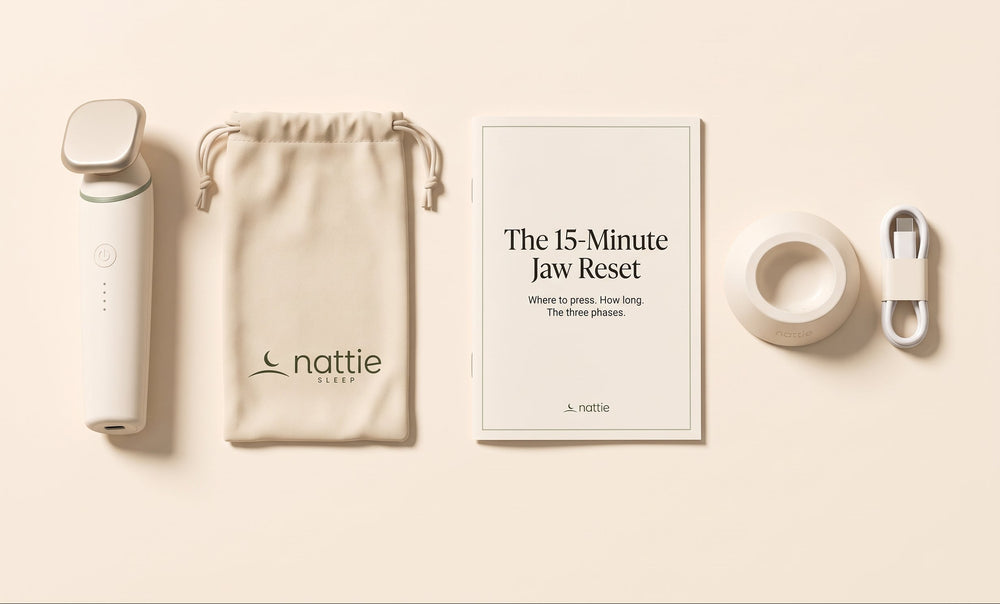
What's included
- NattieRelease device with precision aluminium tip
- USB-C charging base
- Travel pouch
- The 15-Minute Jaw Reset guide (PDF): where to press, how long, and what to do the first three nights
100-Night Home Trial
Use it every night for 100 nights. If you don't wake up one morning and realise your jaw simply isn't there any more, email us at info@nattiesleep.co.uk, we send a prepaid label, and you get every penny back. No forms. No restocking fee. No questions. Plus a 1-year guarantee on the device.
Free tracked UK delivery, 3 to 5 working days.
Get NattieRelease, £99 →We're an honest sleep brand from the UK. We'd rather make one thing that works than ten things that sound clever.
Nattie Sleep · The honest sleep brand · info@nattiesleep.co.uk