
Top Dentist: "Your Bruxism Could Be a Starving Muscle in Disguise"
Manchester dentist breaks ranks on the £300 night guard, and reveals the 15-minute trick that stopped "permanent" clenching for hundreds of his patients (without guards, Botox or sleeping tablets)

I'm about to upset every dentist, dental lab and Botox clinic in Britain.
Because what I'm about to share could cost them millions in night guards nobody needs.
But I don't care.
After watching my wife cry at the kitchen table because she couldn't open her mouth for toast…
After fitting more than 2,000 night guards in 22 years and never once asking why the clenching didn't stop…
After nearly losing the thing I love about my job, which is fixing people…
I discovered something that changed everything.
And if you're reading this with a tight jaw, a headache sitting behind your eyes, and a £300 piece of plastic on your bedside table that hasn't changed a single morning…
The next 5 minutes could be the most important of your life.
My name is Dr. Simon Hartley, BDS.
I've been a dentist for over 22 years. I've worked with everyone from teenagers grinding through exams to 80-year-olds who've worn a groove into their molars.
And I'm about to expose the quiet secret that keeps millions of Britons trapped in "incurable" clenching, while my profession hands out plastic and calls it treatment.
But first, do this. It takes 30 seconds.
THE 30-SECOND TEST
Put two fingers on the side of your face, just in front of your ear. Clench your teeth. Feel that bulge harden? Now open your mouth halfway and press into it, firmly, in a small circle.
If it's tender, if there's a knot the size of a grape, if you winced, you've just found the thing your night guard has never touched.
Count how many of these are true for you:
- Tight or aching jaw when you wake up
- Headaches at the temples or behind the eyes, worst in the morning
- You can't open as wide first thing as you can by lunchtime
- Your jaw clicks or feels off centre when you yawn
- Your face looks wider or squarer at the jaw than it used to
- Your partner has heard you grinding
Two or more and you're in the group I'm about to describe. Four or more and I'd put money on it.

Now let me tell you about the night that changed everything…
THE NIGHT EVERYTHING CHANGED…
It was a Tuesday in February. 2:11 AM.
I woke up because the bed was empty. I found Sarah, my wife of 19 years, sitting at the kitchen table with a hot flannel pressed to the side of her face and tears running down her cheeks.
She couldn't open her mouth. Not properly. Not enough to eat.
And here's the part that still makes me sick: she was wearing the night guard I had fitted her myself.
The best one I make. Hard acrylic, dual layer, perfect impressions. £340 to any patient. Free to my wife.
It was doing its job beautifully. Her teeth were perfect.
And she was crying at the kitchen table because her jaw was set like concrete.
In 22 years I had fitted over 2,000 of those guards. I had told over 2,000 people "this will protect your teeth", and every one of them had nodded, and I had never once stopped to ask the obvious question.
What is it protecting them from?
Because whatever it was, it was still there. Every night. In my own kitchen.

THE MIND-BLOWING DISCOVERY
The next morning I did something I should have done two decades earlier.
I put my fingers on my wife's jaw.
Not on her teeth. On the muscle. The masseter, the big one at the angle of the jaw that closes your mouth.
It was like pressing a walnut. Hard, hot, and so tender she pulled away.
I rang a physiotherapist I refer to for neck patients, Hannah Reeves in Leeds, and described it. She laughed. Not kindly.
"Simon, you've been treating the teeth for 22 years. Nobody's been treating the muscle."
She came over that weekend. She warmed the muscle, worked into it for twenty minutes, and Sarah opened her mouth and burst into tears again, for a different reason.
Then Hannah said the sentence I now repeat to every patient who walks in with a guard in a plastic box:
"She doesn't have a teeth problem. She has a starving muscle. And your guard can't feed a muscle."
I went back to my notes that Monday. Every patient I'd fitted with a guard for "stress bruxism" in the last two years. Forty-one of them.
I called them in, one by one, and put my fingers where Hannah had put hers.
Thirty-three had a masseter I could have found with my eyes closed. Hard. Knotted. Tender to the lightest touch.
Thirty-three out of forty-one. And not one of them had ever heard the word.

Picture a muscle like a sponge soaked in blood.
When it works and rests, works and rests, the sponge fills and empties. Blood in. Oxygen in. Waste out. That's a healthy muscle.
Now squeeze the sponge in your fist and don't let go.
That's a clench. A sustained contraction physically crushes the vessels that feed the muscle. No blood in. No oxygen in. No waste out. For hours.
And here's the kicker:
A muscle without blood doesn't relax. It seizes.
You already know this. It's a calf cramp at 3am. You don't stretch it away. You rub it, you warm it, the blood comes back, and it lets go.
A cramping muscle clenches harder. So it starves more. So it clenches harder.
Clench. Starve. Seize. Clench harder. All night. Every night.
Now the part nobody in my profession will say out loud.
The masseter is the strongest muscle in the human body for its size. It can close your jaw with the force of about 90 kilos. Every hour you concentrate, at a screen, in traffic, in a meeting, it loads a little. By bedtime it's already tired. Then you fall asleep, and it does what a tired, overloaded muscle does: it locks.
Stress lit the match. Years ago, probably. But the fire has been burning on its own ever since, and it runs on one fuel: a starving muscle.
I call it the starving masseter.
And I want you to understand what this means for you:
A starving muscle feels EXACTLY like a stressed muscle.
Tight jaw. Headaches. Clicking. Aching teeth. A mouth that won't open.
Exactly the same symptoms. Completely different cause.
The dental industry KNOWS the guard doesn't stop the clenching. The NHS website says it in plain English: a mouth guard will "protect your teeth from damage". Protect. Not stop. Nobody claims otherwise. They just never tell you the difference.

Here's the worst part.
There's no money in fixing it.
Why? Because a starving muscle is mechanical. You can't drill it. You can't fill it. You can't fit a splint to it.
You can only feed it. And you can't bill for feeding a muscle.
A night guard is £150 to £600 and needs replacing every couple of years. Botox is £350 every three months, for life. A dentist can build a practice on that.
Fifteen minutes of heat and pressure at home, once a night? There's no appointment in it. No lab fee. No repeat visit.
So the whole system defaults to the one thing it can hand you in a box.
Plastic.
It's not a conspiracy. It's worse than a conspiracy. It's a habit. Two thousand of my own patients are proof of it.
What Hannah did to Sarah in our kitchen wasn't clever. It's what physios do to a locked shoulder or a seized calf every day of the week.
Real heat first. Not "warm to the touch". 42 to 48 degrees at the muscle, held there long enough for the crushed vessels to open and let blood back in.
Then pressure and vibration, traced along the muscle from the cheekbone to the angle of the jaw, then up to the temple. That's what breaks the knot.
Then a minute of heat and light pressure on both sides, so the muscle goes to bed fed and unloaded instead of starving and locked.
Fifteen minutes. Every evening.
Sarah did it with a hot flannel and Hannah's thumbs for a week and the difference was so obvious that I went looking for a way she could do it herself, every night, without a physio in the kitchen.
I found it. And then I did something no dentist I know has ever done.
I offered it to the thirty-three patients with the knotted masseters. Not instead of their guard. Alongside it, for 30 nights.
Twenty-nine came back.
Twenty-six of them told me the same thing, in almost the same words: "I woke up and my jaw wasn't there."
Nineteen had stopped wearing their guard by week three. Not because I told them to. Because they forgot to put it in and nothing happened.
I had spent 22 years and 2,000 guards protecting teeth from a muscle nobody was treating.

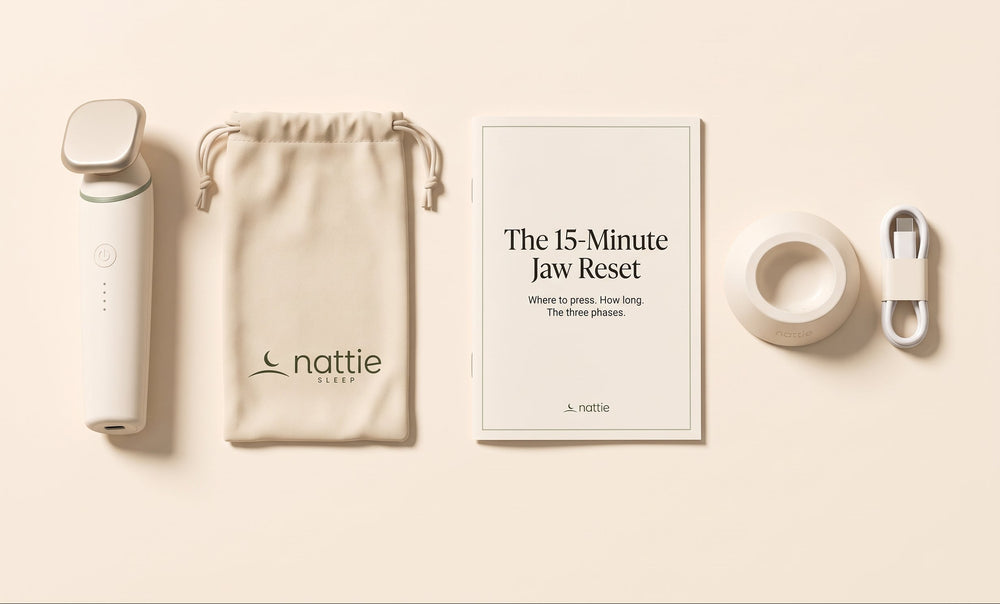
It's called NattieRelease.
And it's the only device I've found that does all three things a starving jaw muscle needs, at home, in one session:
- DEEP HEAT PERFUSION at 42 to 48 °C that reopens the vessels a clench has been crushing, like a physio's hot pack held exactly where it's needed
- TRIGGERPOINT VIBRATION in four levels that breaks the knot from the inside, like a physio's thumbs
- A PRECISION ALUMINIUM TIP shaped to sit on the belly of the masseter and the temporalis, the two muscles that lock your jaw and give you the headache
All three. In your hand. Fifteen minutes.
You literally sit on the edge of your bed, press one button, and let the muscle eat.
No appointments. No injections. No plastic.
Just your jaw finally getting what it's been screaming for: BLOOD. OXYGEN. RELEASE.

When you sit down with NattieRelease, here's what happens:
- 0 to 5 minutes: the Perfusion Phase. The tip warms to 42 °C within 40 seconds. You hold it on the masseter and feel the heat sink in. This is blood coming back into a muscle that's been shut for hours. Most people feel the jaw drop a few millimetres on its own in the first two minutes. That's years of clenching finally letting go.
- 5 to 10 minutes: the Release Phase. You switch on the vibration and trace the muscle from the cheekbone down to the angle of the jaw, then the temple. Pressure and pulse do what Hannah's thumbs did in my kitchen: they break the knot the clench has tied. Think of it like CPR for a muscle. Bringing starved tissue back to life.
- 10 to 15 minutes: the Reset Phase. Heat and light pressure on both sides. The muscle goes to bed fed and unloaded instead of starving and locked. This is the step EVERYONE else misses. And why the clenching always comes back.
After 15 minutes? You go to bed with a jaw that feels like it belongs to someone who's never heard of bruxism.
Not "numbed" like after ibuprofen. Not "protected" like with a guard.
Actually. Fed.

THE RESULTS THAT HAVE DENTISTS SCRAMBLING
Sarah, my wife, week 1: "It's quieter. Like someone turned the volume down." Week 3: ate a steak. Week 5: put the guard I made her in a drawer, where it still is.
★★★★★“I'd worn a guard for six years. Night 15, I woke up without the headache for the first time I can remember.”
Rachel M., 41, Bristol

★★★★★“My dentist wanted £480 for a hard splint. I tried this first. Three weeks in, my husband asked what had happened to the grinding.”
Jennifer L., 46, Glasgow

★★★★★“I'd had Botox twice. Both times it wore off and came back worse. This is the first thing that changed how my jaw feels in the morning rather than numbing it for a few months.”
Danielle K., 38, London

★★★★★“My wife bought it for me as a last resort before separate bedrooms. Night six she slept through for the first time in two years.”
Tom H., 52, Sheffield

★★★★★“I'm a dental nurse. I rolled my eyes at the 'starving muscle' thing. I'm on night 40 and I haven't worn my splint since night 18.”
Priya S., 39, Leicester

100-Night Home Trial · 1-Year Guarantee · Free tracked UK delivery
THE PRICE THAT'S UPSETTING THE DENTAL INDUSTRY
Let's be honest about what you've already spent.
A soft guard: £150 to £300. A hard one: £300 to £600. The NHS one, if you can get it: £332.10 and months of waiting. Botox: £250 to £450, every three months, for life. A physio: £65 a session, twice a week, for three months.
Sarah's total before that Tuesday night: £900. Most of my patients: more.
NattieRelease should cost what a physio costs. Because it does what a physio does.
It costs £99. Once. Was £199.
Less than one Botox session. Less than one private guard. For life.
THE 50% OFF "IN YOUR FACE" TO EVERY NIGHT GUARD IN BRITAIN
Nattie Sleep is launching NattieRelease in the UK this autumn at half the planned price, because they want a thousand British jaws fed before the clocks go back at the end of October, and they want the reviews that come with them.
So for now: £99 instead of £199. Pack for two: £169. Free tracked UK delivery. The 15-Minute Jaw Reset guide included.
BUT HERE'S THE CATCH (AND IT'S A BIG ONE)
The introductory price ends when the first thousand are gone, and I'm told they're going faster than planned. I'm not going to invent a countdown clock for you. I'm telling you what I'd tell a patient: the price goes up, and every month a starving muscle stays starved, it locks a little tighter and the teeth wear a little further.
Nothing about this gets better on its own.
£99 instead of £199 · First 1,000 UK units · No countdown, no games
MY PERSONAL 100-NIGHT "JAW FREE" GUARANTEE
Look, I get it. You've been burned before. Guards, injections, pillows, apps that turned out to be expensive placebos.
So here's the promise, and Nattie Sleep stands behind it:
Try NattieRelease for 100 nights. Use it every single night. Twice a day if you want.
Feel the heat sink in… Feel the knot let go… Feel your jaw stop being the first thing you notice in the morning…
And if you don't wake up one morning thinking "hang on, where's my jaw?"…
You get every penny back.
No forms to fill out. No "store credit" nonsense. No questions asked.
Just email info@nattiesleep.co.uk and say "it didn't work". They send a prepaid label, and your refund is back within days. Plus a 1-year guarantee on the device itself.
Why am I so confident? Because I've watched twenty-six of thirty-three of my own patients wake up without a jaw. After 22 years of plastic, I know what a real result looks like.
THE CHOICE THAT WILL DEFINE YOUR NEXT DECADE
You have two options.
- Option 1: Keep the guard. Keep protecting your teeth from a muscle nobody is treating. Wake up tomorrow, and next year, and in ten years, with the same jaw, worn-down molars, a clicking joint and a headache you've stopped mentioning because nobody has an answer.
- Option 2: Spend 15 minutes tonight feeding the muscle. Give it 100 nights. Find out what your mornings feel like when your jaw isn't the first thing you notice.
I fitted 2,000 guards before I asked the right question. Don't wait for a Tuesday at 2:11 AM to ask it.
HERE'S EXACTLY WHAT TO DO NEXT
- Click the button below.
- Choose one device, or the pack for two if your partner clenches too.
- Tonight, 15 minutes before bed, hold the heat on the muscle and let it eat.
- Keep your guard in for the first two weeks if it makes you feel safer. Most people forget it by week three.
100-Night Home Trial · 1-Year Guarantee · Free tracked UK delivery
Dr. Simon Hartley, BDS, has practised dentistry in Manchester for 22 years. He has no financial interest in Nattie Sleep beyond the agreement to share his findings with its customers. NattieRelease is designed to supplement, not replace, your dental care.
Nattie Sleep · The honest sleep brand · info@nattiesleep.co.uk